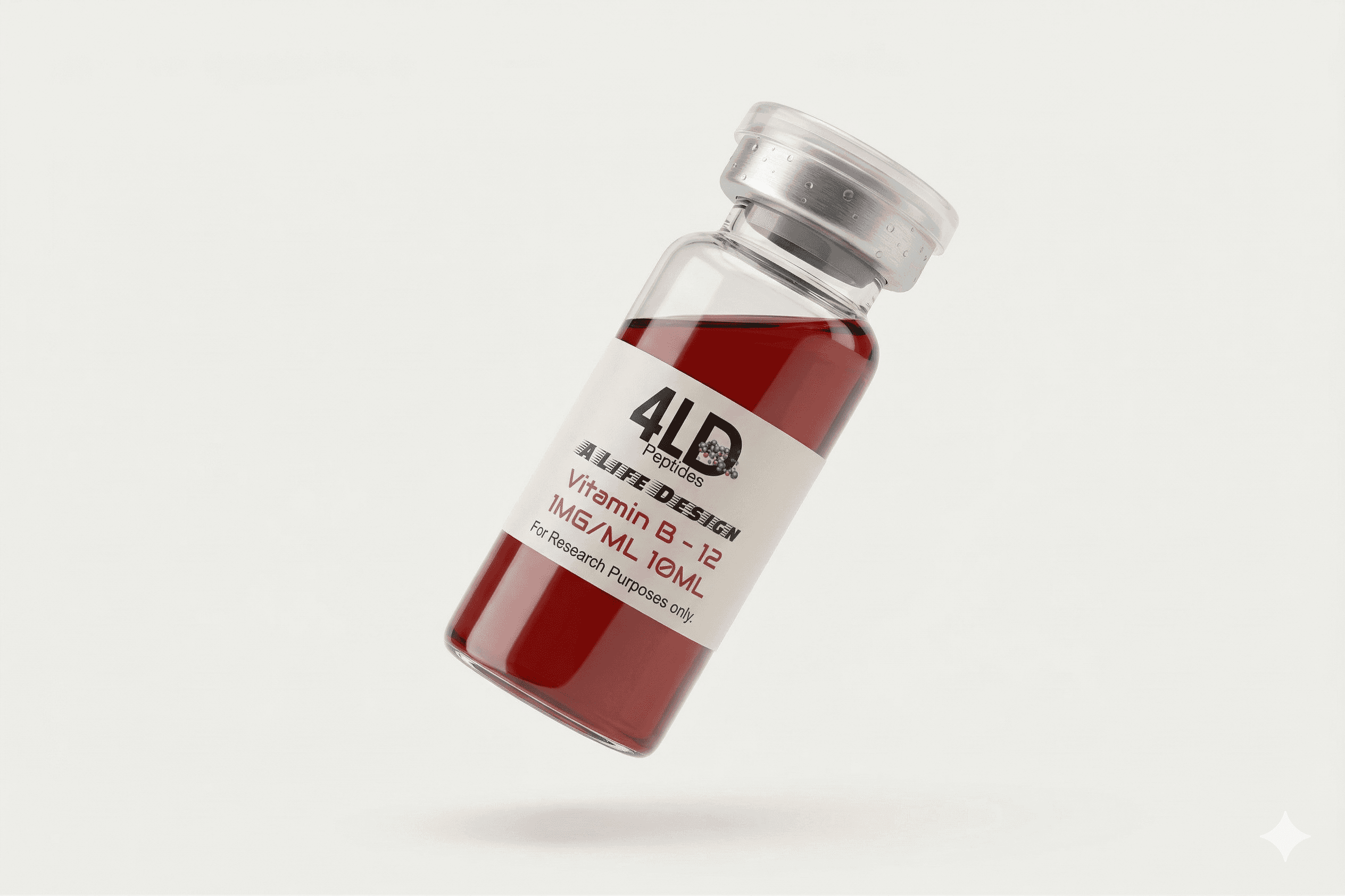
Vitamin B-12 (Cobalamin) — Research Overview
Vitamin B-12 (Cobalamin) is an essential water-soluble vitamin and cofactor involved in some of the most fundamental biochemical processes in mammalian cellular biology. It exists in several biologically active forms including methylcobalamin and adenosylcobalamin, each serving distinct roles as enzyme cofactors in critical metabolic pathways. Its involvement in methionine synthase activity — which connects it directly to folate metabolism, DNA methylation, and one-carbon cycle function — and its role in methylmalonyl-CoA mutase activity within mitochondrial energy metabolism have made it a widely studied compound in neurological, hematological, and metabolic research. Available from 4-LD in lyophilized form, B-12 is produced under quality-controlled conditions for qualified researchers and laboratory professionals conducting in-vitro research applications.
Areas of Active Research
Vitamin B-12 has been studied across several active research areas. In neurological research, studies have examined its essential role in myelin sheath synthesis and maintenance, with deficiency models in cell culture and animal subjects demonstrating associations between B-12 depletion and axonal degeneration, impaired nerve conduction, and cognitive decline markers. In hematological research, laboratory models have investigated its role in red blood cell maturation and DNA synthesis within rapidly dividing hematopoietic cells, with deficiency models producing megaloblastic changes that have been widely used as a research tool for studying erythropoiesis. In metabolic research, studies have examined its function as a cofactor in the conversion of homocysteine to methionine and methylmalonyl-CoA to succinyl-CoA, with findings linking B-12 status to homocysteine accumulation and its downstream effects on cardiovascular and neurological tissue models. In epigenetic research, its role in the one-carbon cycle and its influence on DNA methylation patterns have been studied in models examining gene expression regulation and cellular differentiation. All findings referenced are from preclinical and in-vitro studies. This product is intended solely for laboratory research by qualified professionals and is not for human or animal consumption. 4-LD makes no therapeutic claims regarding this compound.
b-12-10ml
b-12-10ml
b-12-10ml
b-12-10ml
b-12-10ml
Warranty
Shipping details
Customer support
Loading stock...
Vitamin B-12 (Cobalamin) — Research Overview
Vitamin B-12 (Cobalamin) is an essential water-soluble vitamin and cofactor involved in some of the most fundamental biochemical processes in mammalian cellular biology. It exists in several biologically active forms including methylcobalamin and adenosylcobalamin, each serving distinct roles as enzyme cofactors in critical metabolic pathways. Its involvement in methionine synthase activity — which connects it directly to folate metabolism, DNA methylation, and one-carbon cycle function — and its role in methylmalonyl-CoA mutase activity within mitochondrial energy metabolism have made it a widely studied compound in neurological, hematological, and metabolic research. Available from 4-LD in lyophilized form, B-12 is produced under quality-controlled conditions for qualified researchers and laboratory professionals conducting in-vitro research applications.
Areas of Active Research
Vitamin B-12 has been studied across several active research areas. In neurological research, studies have examined its essential role in myelin sheath synthesis and maintenance, with deficiency models in cell culture and animal subjects demonstrating associations between B-12 depletion and axonal degeneration, impaired nerve conduction, and cognitive decline markers. In hematological research, laboratory models have investigated its role in red blood cell maturation and DNA synthesis within rapidly dividing hematopoietic cells, with deficiency models producing megaloblastic changes that have been widely used as a research tool for studying erythropoiesis. In metabolic research, studies have examined its function as a cofactor in the conversion of homocysteine to methionine and methylmalonyl-CoA to succinyl-CoA, with findings linking B-12 status to homocysteine accumulation and its downstream effects on cardiovascular and neurological tissue models. In epigenetic research, its role in the one-carbon cycle and its influence on DNA methylation patterns have been studied in models examining gene expression regulation and cellular differentiation. All findings referenced are from preclinical and in-vitro studies. This product is intended solely for laboratory research by qualified professionals and is not for human or animal consumption. 4-LD makes no therapeutic claims regarding this compound.
Discreet shipping
Fast shipping
High Quality
