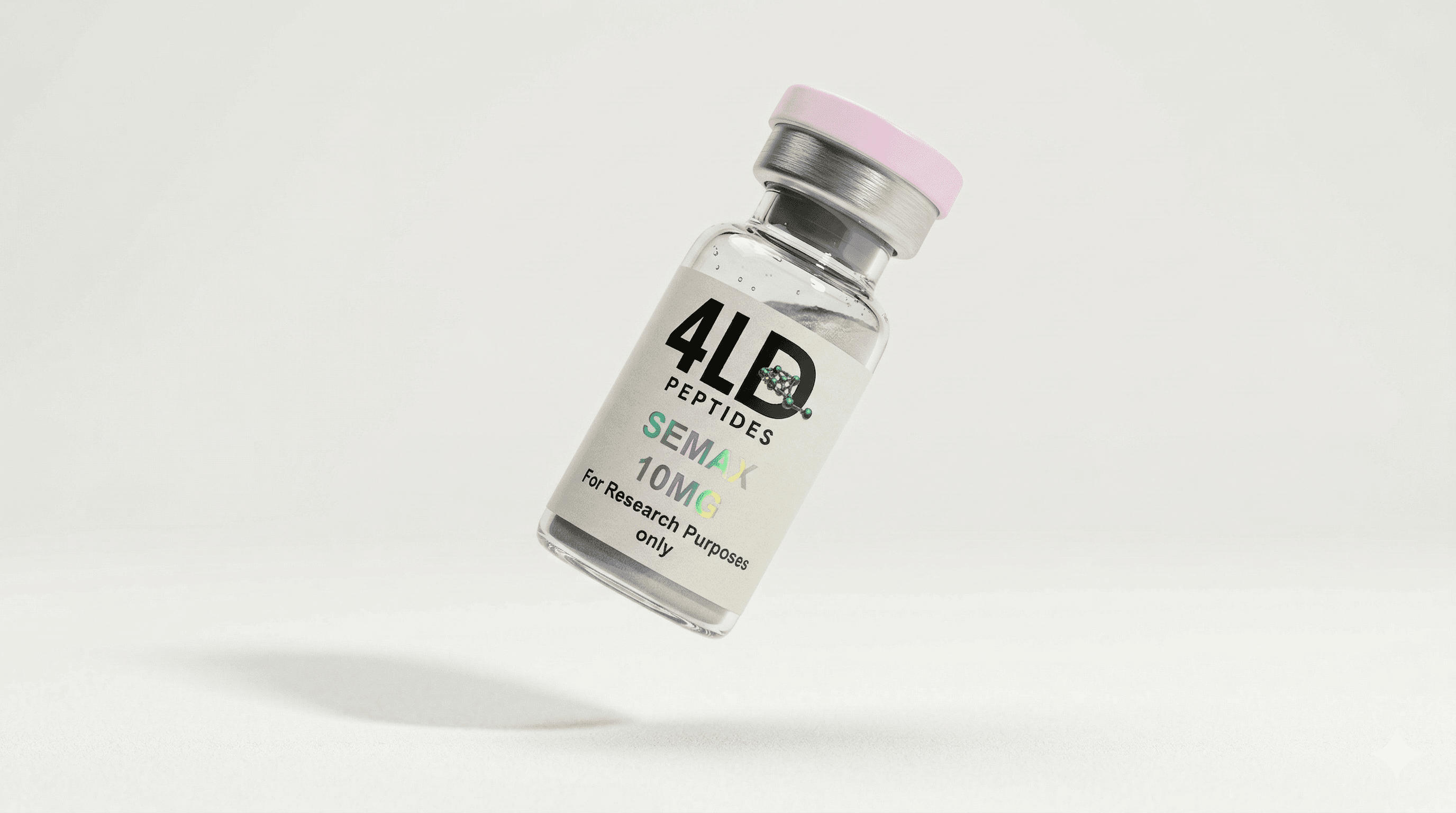
Semax — Research Overview
Semax is a synthetic heptapeptide with the sequence Met-Glu-His-Phe-Pro-Gly-Pro, structurally derived from a fragment of adrenocorticotropic hormone (ACTH). Originally developed in Russia, it has become a widely referenced compound in preclinical neurological research due to its observed influence on multiple neurological pathways including Brain-Derived Neurotrophic Factor (BDNF) expression, dopaminergic and serotonergic system modulation, neuronal survival signaling, and antioxidant defense mechanisms in the brain. Its broad research profile across cognitive function, neuroprotection, stress physiology, and ophthalmic studies has made it a compound of sustained interest in neuroscience laboratory settings. Available from 4-LD in 5mg lyophilized form, Semax is produced under quality-controlled conditions exclusively for qualified researchers and laboratory professionals conducting in-vitro and controlled research applications.
Areas of Active Research
Semax has been studied across several active research areas. In cognitive and memory research, rodent model studies have examined its influence on learning and memory task performance, including passive avoidance and Morris water maze protocols, with findings suggesting associations with BDNF upregulation, enhanced brain energy metabolism, and modulation of neurotransmitter systems related to attention and information processing. In neuroprotection research, animal models of ischemic stroke and traumatic brain injury have investigated its potential to reduce infarct volume, decrease excitotoxic neuronal damage from excess glutamate, inhibit apoptotic pathways, and support cerebral blood flow recovery following injury. In ophthalmic research, preclinical studies have examined its potential neuroprotective effects on retinal ganglion cells in models of optic nerve damage, retinal ischemia, and neurodegenerative eye conditions, with findings suggesting protective effects extending across the visual pathway. In stress and emotional regulation research, animal behavioral studies using elevated plus maze and open field tests have examined its anxiolytic-like properties and its influence on HPA axis function, with findings suggesting it may modulate stress responses without producing the sedative effects associated with conventional anxiolytic compounds. All findings referenced are from preclinical and in-vitro studies. This product is intended solely for laboratory research by qualified professionals and is not for human or animal consumption. 4-LD makes no therapeutic claims regarding this compound.
semax-10mg
semax-10mg
semax-10mg
semax-10mg
semax-10mg
Warranty
Shipping details
Customer support
Loading stock...
Semax — Research Overview
Semax is a synthetic heptapeptide with the sequence Met-Glu-His-Phe-Pro-Gly-Pro, structurally derived from a fragment of adrenocorticotropic hormone (ACTH). Originally developed in Russia, it has become a widely referenced compound in preclinical neurological research due to its observed influence on multiple neurological pathways including Brain-Derived Neurotrophic Factor (BDNF) expression, dopaminergic and serotonergic system modulation, neuronal survival signaling, and antioxidant defense mechanisms in the brain. Its broad research profile across cognitive function, neuroprotection, stress physiology, and ophthalmic studies has made it a compound of sustained interest in neuroscience laboratory settings. Available from 4-LD in 5mg lyophilized form, Semax is produced under quality-controlled conditions exclusively for qualified researchers and laboratory professionals conducting in-vitro and controlled research applications.
Areas of Active Research
Semax has been studied across several active research areas. In cognitive and memory research, rodent model studies have examined its influence on learning and memory task performance, including passive avoidance and Morris water maze protocols, with findings suggesting associations with BDNF upregulation, enhanced brain energy metabolism, and modulation of neurotransmitter systems related to attention and information processing. In neuroprotection research, animal models of ischemic stroke and traumatic brain injury have investigated its potential to reduce infarct volume, decrease excitotoxic neuronal damage from excess glutamate, inhibit apoptotic pathways, and support cerebral blood flow recovery following injury. In ophthalmic research, preclinical studies have examined its potential neuroprotective effects on retinal ganglion cells in models of optic nerve damage, retinal ischemia, and neurodegenerative eye conditions, with findings suggesting protective effects extending across the visual pathway. In stress and emotional regulation research, animal behavioral studies using elevated plus maze and open field tests have examined its anxiolytic-like properties and its influence on HPA axis function, with findings suggesting it may modulate stress responses without producing the sedative effects associated with conventional anxiolytic compounds. All findings referenced are from preclinical and in-vitro studies. This product is intended solely for laboratory research by qualified professionals and is not for human or animal consumption. 4-LD makes no therapeutic claims regarding this compound.
Discreet shipping
Fast shipping
High Quality
