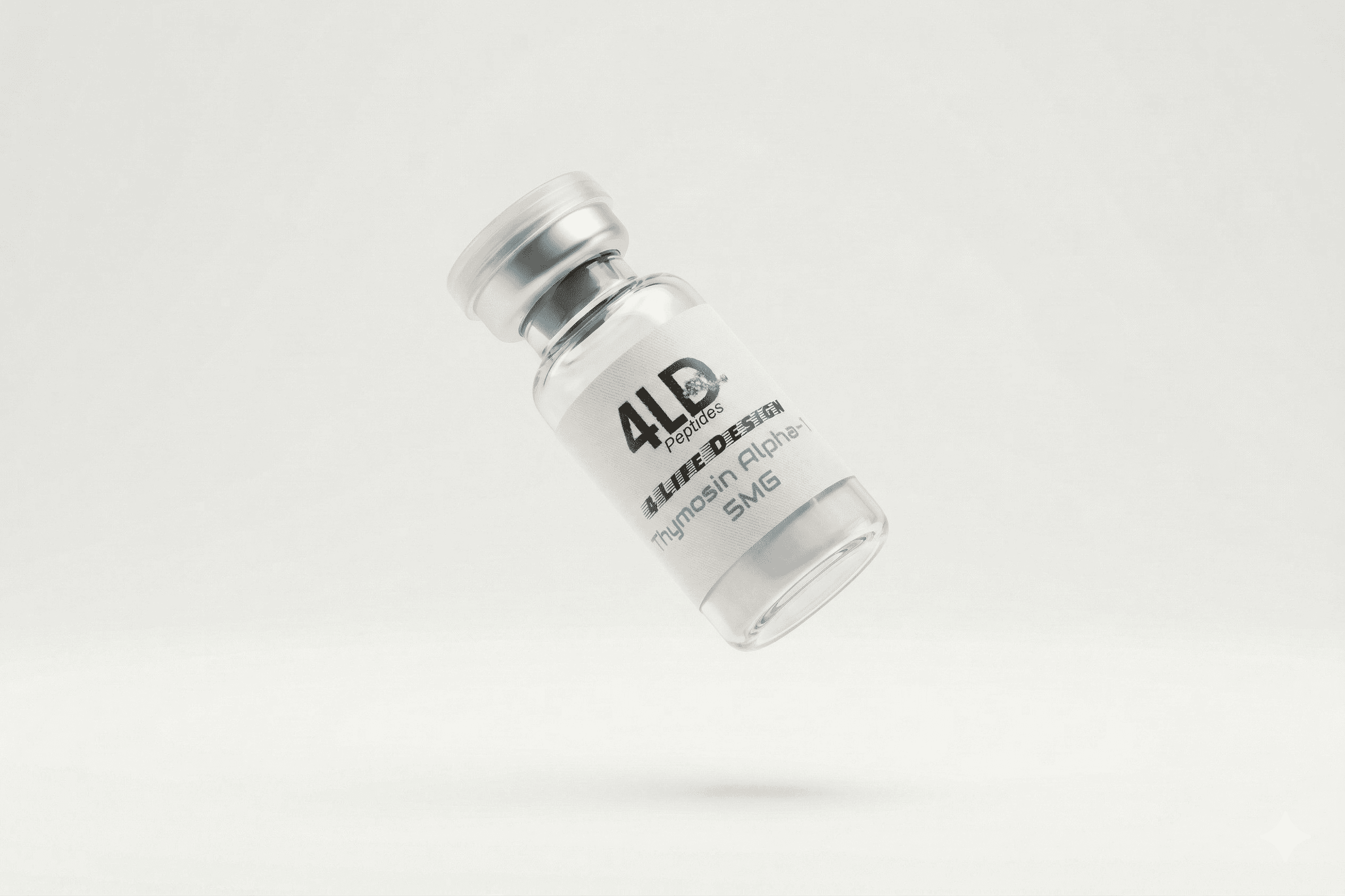
Thymosin Alpha-1 — Research Overview
Thymosin Alpha-1 (TA-1) is a synthetic 28-amino acid peptide originally isolated from the thymus gland with the sequence Ac-Ser-Asp-Ala-Ala-Val-Asp-Thr-Ser-Ser-Glu-Ile-Thr-Thr-Lys-Asp-Leu-Lys-Glu-Lys-Lys-Glu-Val-Val-Glu-Glu-Ala-Glu-Asn-OH. It has become a cornerstone compound in preclinical immunological research due to its broad immunomodulatory properties, particularly its observed effects on T-lymphocyte maturation and differentiation, cytokine regulation, dendritic cell function, and natural killer cell activity. Its ability to influence both innate and adaptive immune pathways across a range of inflammatory and immunodeficiency models has made it a widely referenced compound in immunology, aging biology, and oncological research. Available from 4-LD in 10mg lyophilized form, Thymosin Alpha-1 is produced under quality-controlled conditions exclusively for qualified researchers and laboratory professionals conducting in-vitro and controlled research applications.
Areas of Active Research
Thymosin Alpha-1 has been studied across several active research areas. In immunomodulation research, cell culture and animal studies have examined its effects on T-cell precursor maturation, CD4+ and CD8+ T-cell differentiation, interferon-gamma and interleukin-2 upregulation, and pro-inflammatory cytokine reduction including TNF-α and IL-1, with studies also documenting its influence on dendritic cell antigen-presenting capacity and NK cell cytotoxicity. In anti-aging and immunosenescence research, aged animal models have investigated its potential to promote thymic regeneration, restore naïve T-cell pools, counteract chronic low-grade inflammation associated with aging, and improve immune surveillance function in aged subjects. In oncological research, syngeneic murine tumor models have examined its potential to enhance tumor-infiltrating lymphocyte activity, reduce myeloid-derived suppressor cell populations, and modulate the tumor microenvironment in combination with checkpoint inhibitor approaches. In sepsis and inflammatory research, animal models of cecal ligation and puncture and endotoxin challenge have investigated its effects on cytokine storm modulation, lymphocyte apoptosis prevention, and survival outcomes under hyperinflammatory conditions. All findings referenced are from preclinical and in-vitro studies. This product is intended solely for laboratory research by qualified professionals and is not for human or animal consumption. 4-LD makes no therapeutic claims regarding this compound.
thymosin-alpha-1
thymosin-alpha-1
thymosin-alpha-1
thymosin-alpha-1
thymosin-alpha-1
Warranty
Shipping details
Customer support
Loading stock...
Thymosin Alpha-1 — Research Overview
Thymosin Alpha-1 (TA-1) is a synthetic 28-amino acid peptide originally isolated from the thymus gland with the sequence Ac-Ser-Asp-Ala-Ala-Val-Asp-Thr-Ser-Ser-Glu-Ile-Thr-Thr-Lys-Asp-Leu-Lys-Glu-Lys-Lys-Glu-Val-Val-Glu-Glu-Ala-Glu-Asn-OH. It has become a cornerstone compound in preclinical immunological research due to its broad immunomodulatory properties, particularly its observed effects on T-lymphocyte maturation and differentiation, cytokine regulation, dendritic cell function, and natural killer cell activity. Its ability to influence both innate and adaptive immune pathways across a range of inflammatory and immunodeficiency models has made it a widely referenced compound in immunology, aging biology, and oncological research. Available from 4-LD in 10mg lyophilized form, Thymosin Alpha-1 is produced under quality-controlled conditions exclusively for qualified researchers and laboratory professionals conducting in-vitro and controlled research applications.
Areas of Active Research
Thymosin Alpha-1 has been studied across several active research areas. In immunomodulation research, cell culture and animal studies have examined its effects on T-cell precursor maturation, CD4+ and CD8+ T-cell differentiation, interferon-gamma and interleukin-2 upregulation, and pro-inflammatory cytokine reduction including TNF-α and IL-1, with studies also documenting its influence on dendritic cell antigen-presenting capacity and NK cell cytotoxicity. In anti-aging and immunosenescence research, aged animal models have investigated its potential to promote thymic regeneration, restore naïve T-cell pools, counteract chronic low-grade inflammation associated with aging, and improve immune surveillance function in aged subjects. In oncological research, syngeneic murine tumor models have examined its potential to enhance tumor-infiltrating lymphocyte activity, reduce myeloid-derived suppressor cell populations, and modulate the tumor microenvironment in combination with checkpoint inhibitor approaches. In sepsis and inflammatory research, animal models of cecal ligation and puncture and endotoxin challenge have investigated its effects on cytokine storm modulation, lymphocyte apoptosis prevention, and survival outcomes under hyperinflammatory conditions. All findings referenced are from preclinical and in-vitro studies. This product is intended solely for laboratory research by qualified professionals and is not for human or animal consumption. 4-LD makes no therapeutic claims regarding this compound.
Discreet shipping
Fast shipping
High Quality
