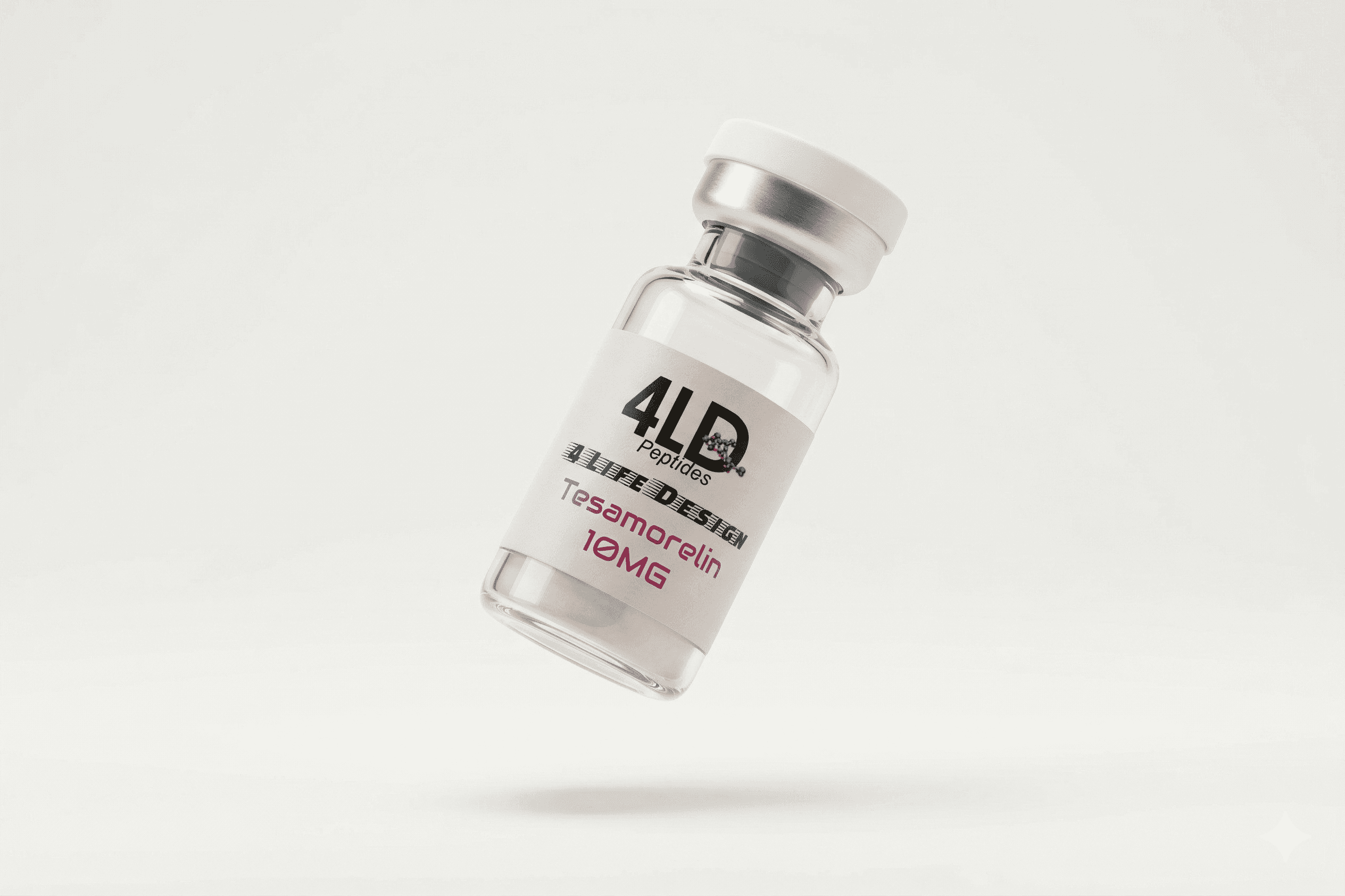
Tesamorelin — Research Overview
Tesamorelin (TH9507) is a synthetic growth hormone-releasing hormone (GHRH) analog comprising the first 29 amino acids of GHRH with a trans-3-hexenoic acid modification that enhances its stability and resistance to enzymatic degradation. This structural design allows it to stimulate pulsatile growth hormone secretion from the anterior pituitary in a manner that more closely mirrors natural physiological patterns compared to direct GH administration, making it a relevant tool for research examining selective metabolic effects without the proliferative concerns associated with continuous GH exposure. Its downstream stimulation of IGF-1 production and its observed preferential effects on visceral adipose tissue have made it a widely referenced compound in metabolic, body composition, and cardiovascular research. Available from 4-LD in 10mg lyophilized form, Tesamorelin is produced under quality-controlled conditions exclusively for qualified researchers and laboratory professionals conducting in-vitro and controlled research applications.
Areas of Active Research
Tesamorelin has been studied across several active research areas. In visceral adiposity and body composition research, primate and rodent models have examined its effects on visceral fat reduction, lean mass preservation, and waist circumference changes through enhanced lipolysis and reduced adipocyte hypertrophy mechanisms, with findings consistently documenting its preferential action on visceral rather than subcutaneous adipose tissue. In lipid metabolism and cardiovascular research, studies in dyslipidemic and atherosclerosis-prone animal models have investigated its influence on triglyceride levels, LDL and HDL profiles, apolipoprotein composition, and small dense LDL particle reduction. In insulin sensitivity and metabolic syndrome research, insulin-resistant animal models have examined its effects on HOMA-IR scores and glucose homeostasis, with studies suggesting improvement in insulin sensitivity through both direct and IGF-1 mediated mechanisms. In hepatic research, models of hepatic steatosis have explored its potential to reduce liver fat content and improve hepatic enzyme profiles through enhanced fatty acid metabolism. All findings referenced are from preclinical and in-vitro studies. This product is intended solely for laboratory research by qualified professionals and is not for human or animal consumption. 4-LD makes no therapeutic claims regarding this compound.
Tessamorelin 10MG
Studied for pulsatile growth hormone secretion, GHRH receptor activation, and visceral adiposity research
Researched for lipid metabolism, insulin sensitivity, and hepatic steatosis model applications
$106.00
To place an order or ask a question about this product, reach out directly at support@4ld.com and we'll get back to you promptly.
EMAIL TO ORDER
Tesamorelin — Research Overview
Tesamorelin (TH9507) is a synthetic growth hormone-releasing hormone (GHRH) analog comprising the first 29 amino acids of GHRH with a trans-3-hexenoic acid modification that enhances its stability and resistance to enzymatic degradation. This structural design allows it to stimulate pulsatile growth hormone secretion from the anterior pituitary in a manner that more closely mirrors natural physiological patterns compared to direct GH administration, making it a relevant tool for research examining selective metabolic effects without the proliferative concerns associated with continuous GH exposure. Its downstream stimulation of IGF-1 production and its observed preferential effects on visceral adipose tissue have made it a widely referenced compound in metabolic, body composition, and cardiovascular research. Available from 4-LD in 10mg lyophilized form, Tesamorelin is produced under quality-controlled conditions exclusively for qualified researchers and laboratory professionals conducting in-vitro and controlled research applications.
Areas of Active Research
Tesamorelin has been studied across several active research areas. In visceral adiposity and body composition research, primate and rodent models have examined its effects on visceral fat reduction, lean mass preservation, and waist circumference changes through enhanced lipolysis and reduced adipocyte hypertrophy mechanisms, with findings consistently documenting its preferential action on visceral rather than subcutaneous adipose tissue. In lipid metabolism and cardiovascular research, studies in dyslipidemic and atherosclerosis-prone animal models have investigated its influence on triglyceride levels, LDL and HDL profiles, apolipoprotein composition, and small dense LDL particle reduction. In insulin sensitivity and metabolic syndrome research, insulin-resistant animal models have examined its effects on HOMA-IR scores and glucose homeostasis, with studies suggesting improvement in insulin sensitivity through both direct and IGF-1 mediated mechanisms. In hepatic research, models of hepatic steatosis have explored its potential to reduce liver fat content and improve hepatic enzyme profiles through enhanced fatty acid metabolism. All findings referenced are from preclinical and in-vitro studies. This product is intended solely for laboratory research by qualified professionals and is not for human or animal consumption. 4-LD makes no therapeutic claims regarding this compound.
Discreet shipping
Fast shipping
High Quality
